Service
HCD & Service Design
Strategy & Policy Design
Scaling & System Change
Co-Design & Social Innovation
Impact Area
Public Sector
Location
Auckland District Health Board; Tāmaki Wellbeing Initiative; ProCARE; Te Manawanui Collective (Taranaki)
Poor mental health is a significant and growing issue in Aotearoa and abroad, and our health system needed to adapt its approach to better serve those experiencing mental health and addiction issues. ThinkPlace played a co-design role in the design and development of a new model of care, Integrated Primary and Mental Health and Addiction Services (IPMHAS), which has been rolled out in various forms across the country. General practices are now able to offer holistic, whānau-centred, timely and ongoing health and wellbeing support.

The context
Each year, one in five New Zealanders experience mental health or addiction challenges. The number of people who experience psychological distress is increasing, with recent statistics showing over 14% of adults in Aotearoa reporting high or very high distress. These numbers are even higher for young adults, and for Māori, Pacific and disabled adults. Year after year, there is a significant number of adults who want professional help for their mental health or substance abuse, but do not receive it.
In most instances, a general practice (GP) is where people would first raise or seek support for their mental distress. Historically, where patients were identified as having severe mental health support needs (roughly 3% of the population), GPs would refer them to external specialist services. Yet many more people experience more common and (generally) less severe mental wellbeing issues such as anxiety, depression, low mood and stress. This group (known as ‘the missing middle’) would have difficulty accessing support due to barriers such as affordability, long wait times, and restrictive referral processes or criteria. GP appointments are short, limiting the time, connection and ongoing support that is often required to address key social drivers of poor mental or physical health.
The 2018 Government Inquiry into Mental Health and Addiction called for better access and more choice, especially for people with mild to moderate needs. This led to pilots, expansion of existing services, and the introduction of a new model of care across the country. This model has different names throughout the country, recognising that one general model of care cannot work for everyone, such as Te Tumu Waiora, Tū Whakaruruhau, and Te Manawanui. Broadly, these sit under the umbrella of Integrated Primary Mental Health and Addiction Services (IPMHAS).
Key features of this model of care, which are still in practice today, include:
~ Recognising the importance of an enhanced general practice team, as well as ‘walk alongside’ community support.
~ Connecting patients with health professionals and support workers who can provide ongoing and cross-sector wellbeing and social support.
~ Integration of mental health and addition services into primary care.
~ Introduction of two new roles: Health Improvement Practitioners (HIPs) and Health Coaches.
~ Providing a holistic practice where patients receive a warm handover to the support practitioner from their GP, often on the same day, ensuring timely and ongoing support.
Our involvement
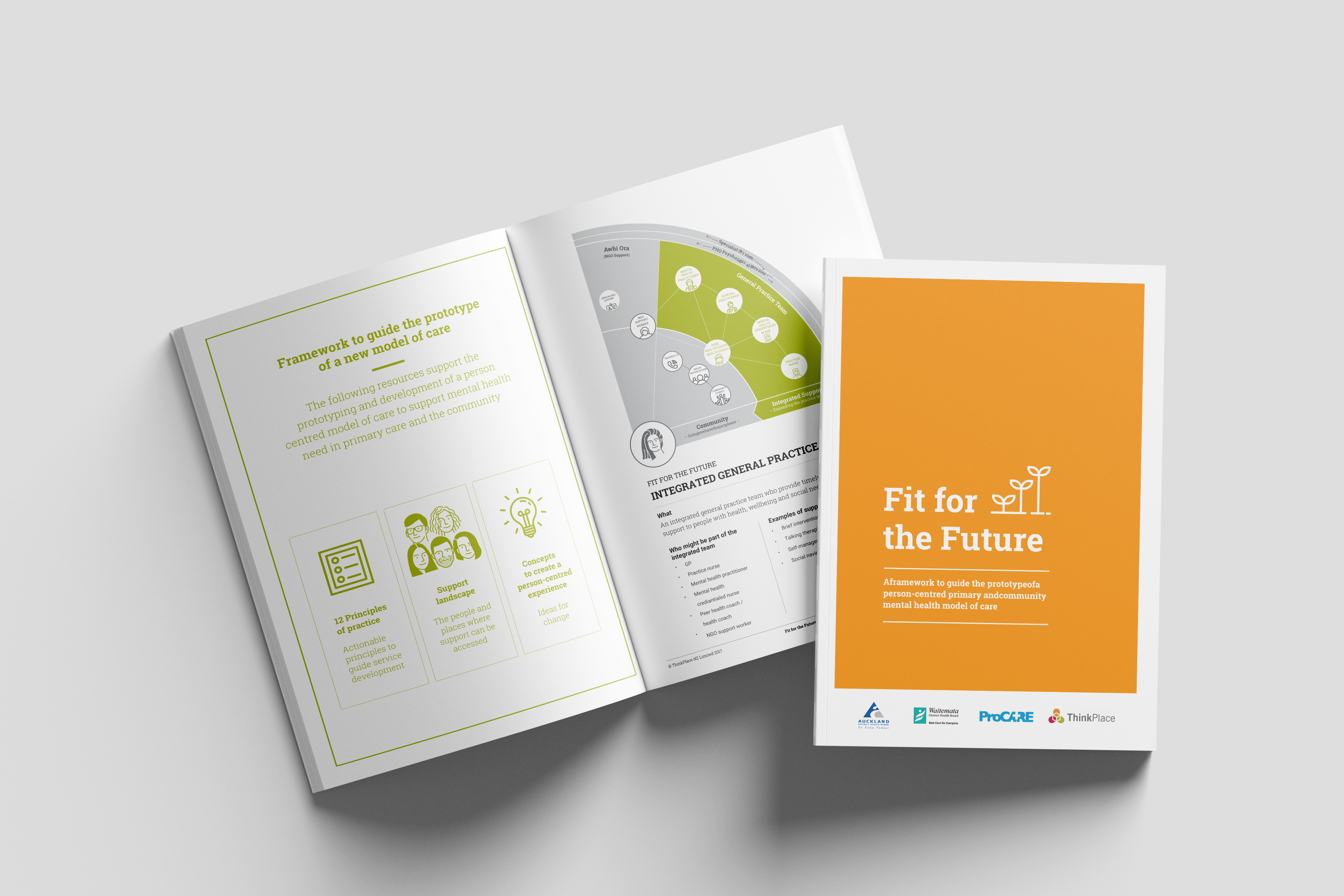
Throughout the design, prototyping and piloting process, ThinkPlace played a role as a co-design partner, working with a number of health boards and organisations, government agencies, and communities, to ensure proposed solutions met the needs of the service users and were appropriately adapted to local contexts. We worked on three key projects as part of the development of the IPMHA model of care. The first was the initial Awhi Ora pilot, working with Tāmaki Wellbeing Initiative, Auckland District Health Board, and ProCARE. We continued this work with Fit for the Future, expanding the pilot across Auckland and Waitematā. We then worked with Pinnacle and Tui Ora to support the design of their roll out of this model in Taranaki.
We contributed to the co-design of a framework for developing a person-centred model of care for IPMHA services. Our role was focussed on co-design facilitation, research and sense-making. We then worked with the Te Manawanui Collective to support the design of their roll out of this model in Taranaki, one of the many regions to adapt this model of care.
Through co-design with communities and stakeholders, and the utilisation of design tools such as personas and system mapping, our work centred on ensuring a whānau-centric approach was taken, and that the model was appropriately adapted to suit the unique needs and contexts of different regions and communities.
The impact
An independent monitoring report by Te Hiringa Mahara Mental Health and Wellbeing Commission (2025) showed the IPMHA Services were available to 68% of those enrolled with general practices across the country – not far from the goal of 70%, which was projected to be met in 2026.
Independent reviews and evaluations, including interviews with patients and general practices, identified hugely positive benefits of this new model of care for people’s access to health and wellbeing support. Evidence shows that the services are reaching those whose needs would have likely gone unmet. More support is available, is easier to access, and is enabling earlier intervention for those needing help with their mental health and wellbeing.
People accessing the services have shared positive feedback about the impact of the services. These benefits included: feeling empowered; making lifestyle changes and improvements; being connected to other community, health and housing supports that they needed; and being equipped with tools to help manage their issues. There have also been benefits for healthcare workers and the system more broadly, reporting less time pressure and overload for GPs, more effective use of medication, less need for specialist referrals.
The video below shares some of these stories of impact:
The 2025 monitoring report highlighted key recommendations for the programme to achieve its objectives. These include the need for enhanced productivity, extended coverage, and a sustained focus on roll-out and delivery.
Resources
Learn more about the IPMHAS available across the country:
Health NZ- Wellbeing support in general practice
Learn more about Awhi Ora, the IPMHA model and their impact:
Te Pou- Integrated Primary Mental Health and Addiction
Auckland Wellbeing Collab- Awhi Ora
Evaluations and reviews:
Synergia’s evaluation of Fit for the Future
Access and Choice programme (which IPMHAS sits within) monitoring report
“In my lengthy experience as a GP it has been perhaps the best scheme in terms of provision of exactly what is required to make a real difference to community health outcomes for individuals, families and therefore the better health of the community.”
– GP (in an independent evaluation of Awhi Ora)
Case studies
View all case studies
Exploring disability inclusion in banking
Read case study
Chinese Boat Safety: Co-Designing Safer Seas with Coastguard NZ
Read case study